AI-generated, human-reviewed.
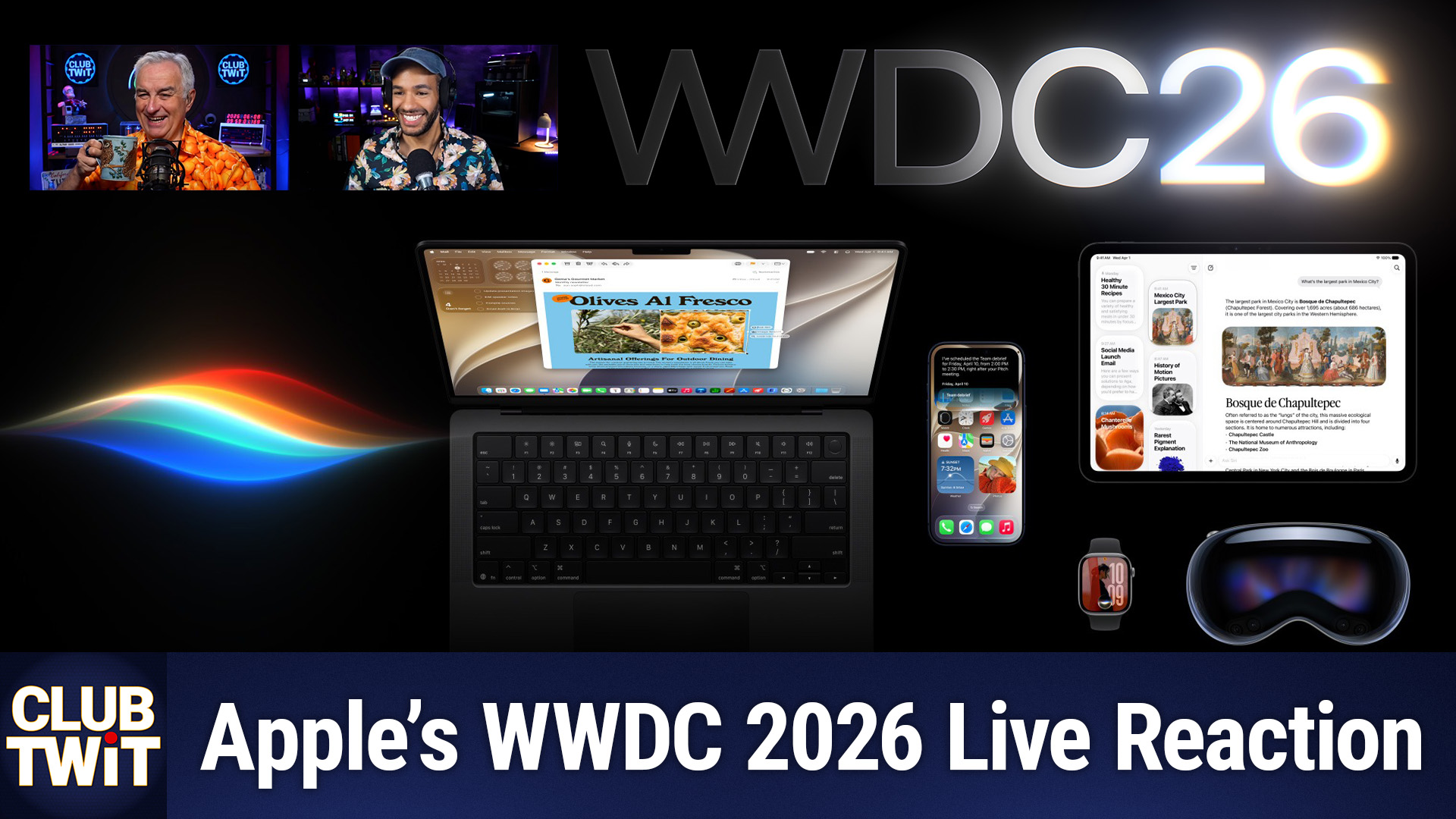
Apple's WWDC 2026 keynote was the company's most consequential software event in years — and Club TWiT members got to watch it unfold in real time with Leo Laporte and Mikah Sargent reacting live. No hardware. No John Ternus cameo. Just Apple making a serious, long-overdue statement about what its platforms can actually do — capped by a genuinely moving farewell from Tim Cook.
What Apple Announced: The Big Picture
Craig Federighi opened by framing the release around three pillars: performance and platform refinement, child safety, and a major leap forward for Apple Intelligence. The new OS lineup — iOS 27, iPadOS 27, macOS Golden Gate, watchOS 27, and visionOS 27 — lands as a free update this fall.
Leo noted the "Snow Leopard energy" of the performance emphasis: Apple wasn't just piling on features but visibly going back to sweat the fundamentals. App launch times are up to 30% faster, photos load up to 70% faster after being taken, AirDrop transfers are up to 80% faster, and a rebuilt CPU scheduler — extended all the way back to iPhone 11 — makes iOS 27 available to more devices than any previous release.
The rebuilt search index across Spotlight, Photos, and Mail was a detail Mikah flagged as long overdue. A completely new ranking system in Mail's Top Hits was called out specifically — the kind of fix that's unglamorous but genuinely matters.
Siri AI: The Rebuild Apple Had to Deliver
The centerpiece of the keynote was Siri AI, described as a ground-up reimagining of Siri powered by Apple Intelligence and a new collaboration with Google using technologies from the Gemini family of models. Leo called it "the first time they've kind of even acknowledged that it's Google in your Siri."
Siri AI brings personal context understanding that can search across messages, emails, photos, and third-party apps; onscreen awareness that lets Siri answer questions about whatever is currently on your display; and broad world knowledge for real-time web lookups. A new dedicated Siri app syncs conversational history across devices via iCloud, so you can start a question on iPhone and continue it on Mac.
Mikah was genuinely impressed by the demos — particularly the multi-step, cross-app task completion. Asking Siri to find photos from a recent trip, identify specific people in them, and add them to a shared family album without opening the Photos app at all is the kind of thing people have wanted for years. Leo's framing was direct: "This is what people want." Both hosts noted the conspicuous parallel to what Google has been doing on Android — and gave Apple credit for what looked like a real, working implementation rather than a slide deck.
Visual Intelligence — Siri's ability to use the camera to understand and act on what it sees — expands beyond iPhone this year to iPad, Mac, and Apple Vision Pro. On Mac, a keyboard shortcut lets users select anything on screen and type a question directly to Siri. Mikah noted he's already doing something similar with Claude; the point is Apple is making it native and frictionless.
New expressive voices with adjustable pace and tone, plus significantly improved system-wide dictation accuracy, round out the Siri upgrade for devices with the most advanced on-device model.
Privacy Architecture: Apple + Google, Handled Carefully
Apple's new Apple Foundation Models run both on-device and on servers via Private Cloud Compute, with the explicit guarantee that personal data is never stored or accessible to Apple or third parties. The Gemini collaboration raised an eyebrow or two in the live reaction — Leo noted rumors of Apple potentially running Private Cloud Compute on Google infrastructure, and possibly even xAI servers, though Apple did not address this directly in the keynote.
The panel's read: Apple was deliberately non-committal about the server-side details. Worth watching as more information emerges from developer sessions.
Parental Controls: A Serious Policy Move
Apple devoted substantial keynote time to overhauled child safety features — a section Mikah flagged as clearly driven by both genuine concern and the current regulatory environment.
The new system centers on child accounts, which immediately enable age-appropriate system-wide protections. From there, parents get:
- Setup Assistant to choose exactly which apps a child can access from day one
- Ask to Browse — an extension of Ask to Buy that requires kids to request permission before visiting a new website in Safari
- Time Allowances across Entertainment, Games, and Social Media categories, with expert-recommended starting points calibrated by age
- Daily Schedules to control app access at different times of day
- A redesigned Screen Time dashboard with at-a-glance usage summaries
- Communication Safety extended to block gore and violent content in shared images and FaceTime calls, not just nudity
Leo pointed out the developer angle: Apple is pushing new APIs — SensitiveContentAnalysis, PermissionKit, and the Declared Age Range API — that let apps receive a child's age range and adjust their experience accordingly without requiring a specific birthdate.
Mikah's take: Apple has historically made parental controls more powerful than easy to use. These changes seem genuinely aimed at closing that gap — and the American Academy of Pediatrics partnership gives the age recommendations credibility beyond marketing language.
Apps: Intelligence Woven In
Safari gets AI-powered tab organization that automatically groups open tabs into topics, plus Notify Me — the ability to tell Safari to monitor a web page for changes (price drops, product restocks) and send a notification when something shifts. Mikah called Notify Me his favorite feature of the show.
Passwords can now automatically fix weak or compromised passwords agentically — navigating to websites on the user's behalf and changing them with a single tap. Messages gains one-tap action suggestions based on conversation context, plus photo-finding that reads the message to identify what's being asked for. Calendar can create events from natural language descriptions. Phone gets Call Context, which proactively surfaces relevant information — a confirmation code, a medical ID number — based on who you're calling, entirely on device.
Image Playground now generates photorealistic images via a new generative model on Private Cloud Compute. Leo suspected Gemini's image capabilities are doing heavy lifting here. The tool has expanded into lock screen wallpapers and contact posters, with image editing via circle-to-select gestures.
Photos introduces three AI editing tools: an upgraded Clean Up for removing distractions, Extend for adding canvas around images without cropping, and the headlining Spatial Reframing — which lets users drag a photo to shift perspective as if they'd repositioned the camera at the moment of capture, then uses generative models to fill in only the newly revealed edges. It works on older photos and photos taken by other cameras.
Shortcuts can now be created by plain-language description, with Apple Intelligence assembling the required steps automatically. Home gets AI-generated descriptions of security camera clips and smarter notification grouping.
The Tim Cook Farewell
The keynote's final minutes belonged to Tim Cook, stepping down as CEO after roughly 14 years. His closing remarks — about imagination having no limits, the honor of advancing Apple's mission — landed genuinely. Leo admitted he almost teared up. Mikah agreed it was handled with exactly the right tone: no explicit "goodbye," just evident pride.
Cook is expected to transition to an executive chairman role, remaining involved in governmental affairs. His successor, John Ternus, was absent from WWDC — Leo and Mikah both expect his formal debut to come at the September iPhone event.
Key Points
- iOS 27 / macOS Golden Gate land as free updates this fall, with developer betas available now and a public beta next month
- Siri AI is a genuine rebuild — conversational, cross-app, contextually aware — powered by Apple Foundation Models and Google's Gemini technologies
- Apple Intelligence features with image generation have daily usage limits; higher access is available via iCloud+ subscriptions
- Siri AI is not available in the EU on iOS/iPadOS at launch; Mac, Apple Watch, and Vision Pro users in the EU can access it. China exclusions continue pending regulatory approval
- Apple Intelligence requires iPhone 15 Pro or later, or iPhone 16 models; iPad with M1 or later; Mac with M1 or later
- No hardware was announced; Mikah and Leo both noted the conspicuous HomePod silence given longstanding rumors of a new model with a screen
- Xcode now supports Gemini as a coding assistant choice, alongside GitHub and Figma integrations — a quiet but significant developer concession
The Bottom Line
WWDC 2026 was Apple delivering on promises it made two years ago and arguably should have made sooner. The Siri rebuild looks real, the parental controls look substantive, and the performance work across the OS is the kind of foundational investment that compounds over time. The Google partnership is out in the open now — partly. The regulatory picture in the EU remains messy. And the question of what exactly is running your private queries on which servers deserves a clearer answer than Apple gave on stage.
Leo's overall verdict: "I think this is exactly in every respect what Apple needed to say." Mikah's: the recurring theme was self-awareness — Apple acknowledging user frustrations, legal pressures, and competitive realities, and responding with specifics rather than vague promises.
Whether the fall delivery matches the keynote is, as always, the real test.
Club TWiT members watched this keynote live with Leo Laporte and Mikah Sargent. Want in on the next one? Join Club TWiT at https://twit.tv/clubtwit


